

Tips for painting with masking fluid and watercolours
If you know me, you know that I love working with masking fluid. I use this medium in almost all my paintings — and it is very common that people ask about it when seeing my videos on Instagram or YouTube.
Here are some of the most asked questions and tips on how to use this medium without ruining your brushes or paper.
What is Masking Fluid?
Also known as liquid frisket, masking fluid is a water-based medium used to repel paint and preserve white areas on paper. It's very handy for keeping small or complex details that would be too difficult to paint around — and also a great way to create unusual effects that would be impossible to do by hand.
What brushes do you use to apply Masking Fluid?
Short answer: (almost) all of them! I go for the not-so-new ones and avoid really expensive brushes. Just please don't buy cheap brushes to throw away after using them — there is no need for that.
We all know that masking fluid can ruin our brushes, but it is all about preparing them correctly. So here is the big secret: Soap.
How to prepare your brushes before dipping them in Masking Fluid?
Mix a teaspoon of liquid soap in a glass of water and soak your brushes in it every time you add more masking fluid — this will also make it easier to apply. Wash your brushes with more soap and under running water immediately after you finish.
What kind of soap?
I always use liquid dishwashing soap. Alternatively you can use bar soap — I've seen other artists do this, but because my brushes are big it's easier to work with soapy water.
What brand do you use? My masking fluid is too thick to paint.
With some exceptions, almost all brands are equally thick — but using soapy water on your brush will dilute it and make it easier to work with. I recommend pouring your masking fluid in a small bowl or plate instead of dipping the brush in the bottle. You can always put it back into the bottle… yes, with soap and everything.
If you still want to know the brand: it is Schmincke blue masking fluid.
Why does my paper tear when I remove it?
The most common reason is that the paper quality is too low. Student grade paper and thin paper don't react well to masking fluid. Another reason can be that the paper was wet when you applied it, or damp when you removed it.
What is the best way to remove the masking fluid?
It depends on the amount used. Small areas can be removed by rubbing with your fingertips or an eraser. For larger areas, a stiff piece of cloth works well — you can see how I do this in my process videos.
Important tips
✦ Work fast and never allow the masking fluid to dry on your brush.
✦ Apply and remove the masking fluid only when the paper is completely dry — otherwise it is easy to tear the paper when removing it.
✦ Don't leave the masking fluid on for more than a week, or it will become too difficult to remove and may damage the paper.
✦ Before removing the masking fluid, use a slightly damp paper towel to clean off the excess pigment — this prevents transferring colour to the white areas.
Online Workshop · Beginner
Introduction to Painting with Masking Fluid & Watercolors
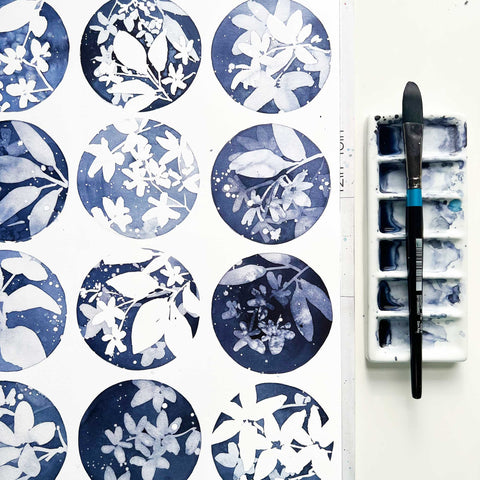
A beginner-friendly class where I walk you step by step through layering with masking fluid and watercolor — in my signature style. You'll learn the fundamentals and how to avoid the most common mistakes.
Enroll here →Watch a short demo
Masking fluid + cyanotype
This is my signature combination.
If you want to take masking fluid further — I combine it with cyanotype printing in almost all my large mixed media paintings. The resist quality of the masking fluid works beautifully with the sun-print process, creating layered textures that are impossible to achieve any other way. I teach this technique in detail in my cyanotype & mixed media class.
See the Cyanotype Class →Online Workshop · Intermediate
Painting with Masking Fluid, Watercolour Washes, Mixed Media & Textures

An intermediate class exploring layers of watercolour washes and masking fluid alongside other mediums like acrylic inks and pigments.
Enroll here →For more information about art supplies, see my recommended supplies.
Comments
Laurel said:
This was SO useful – thank you so much for sharing what has saved you time, brushes, frustration (and, no doubt – projects).
Your work is beautiful!
Noa said:
Gracias por compartir!
Ingrid said:
The white brush I am using is Graduate from Daler Rowney :)
Merche said:
Hello Ingrid. I notice that some brushes that seem very good. Especially one white number 12. What brand are they? Because I don’t end up liking the way I work with mine. A hug